
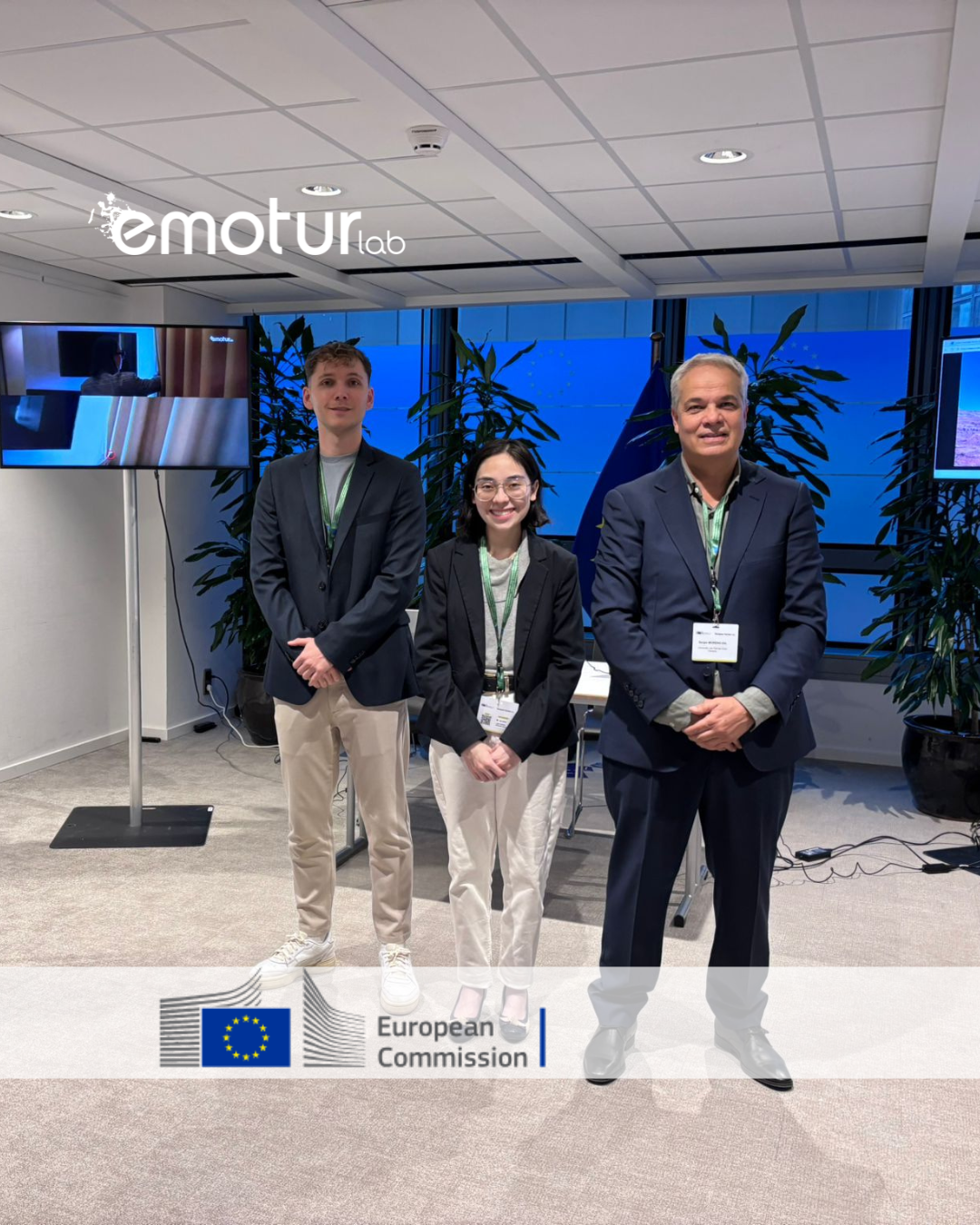
At the European Tourism Day, held on January 26, 2026, in Brussels, the EUROEMOTUR project celebrated its successful conclusion with a high-impact presentation to European institutions. Led by the Emotur Lab team, the project not only demonstrated the power of applied neuroscience but also presented a record of results that guarantees the digital transformation of the sector.
Goals Achieved: A Legacy of Innovation for Europe The EUROEMOTUR project has finished by exceeding its strategic objectives and consolidating an unprecedented innovation ecosystem for small and medium-sized tourism enterprises:
100 SMEs supported: A hundred companies have completed their digital maturity diagnostics.
100 content analysis reports: In-depth evaluations that processed over 54,000 words to understand digital tourism narratives.
Neuroscience in action: 46 Eye-tracking analyses (across Instagram and websites) were successfully conducted to optimize consumer emotional response.
High-level training: The project leaves a legacy of 10 webinars and 9 specialized training modules.
Collaborative network: A robust structure of 84 service providers and an international advisory board.
Taking the Lab to the Streets The live demonstration during the event showed how these neuroscientific metrics—now part of the success of 100 European companies—allow for the measurement of the traveler’s “emotional heartbeat.” EUROEMOTUR has proven that the EU’s digital transition is not just technological, but deeply human and evidence-based.
With these results, EUROEMOTUR concludes its journey, reaffirming its role as the leading hub for the tourism of the future, where emotion and data go hand in hand.